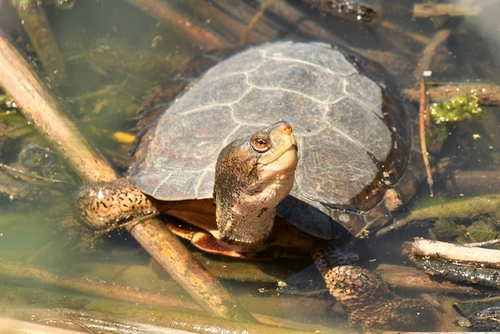
Northwestern pond turtle
On October 3, 2023, the U.S. Fish and Wildlife Service (Service) published two proposed rules to list three species—the northwestern pond turtle (Actinemys marmorata), the southwestern pond turtle (Actinemys pallida), and the short-tailed snake (Lampropeltis extenuata)—as threatened under the Endangered Species Act (ESA). The proposed listings also include proposed 4(d) rules for each species. However, according to the Federal Register notices, the Service concluded that designating critical habitat for each of the three species is not currently determinable, and, therefore, the agency is still in the process of gathering data sufficient to inform potential proposed critical habitat designations.
Northwestern and Southwestern Pond Turtles
The western pond turtle was split into two species, northwestern and southwestern, in 2017. Both species are medium-sized turtles with a historical habitat ranging from British Columbia, Canada in the north, down to Baja California, Mexico in the south. As explained in the proposed rule, the habitat for both species has been drastically reduced, with the northwestern pond turtle nearly extirpated in some regions. Both species feed on small aquatic invertebrates and vertebrates, carrion, and plant material. Accordingly, aquatic habitats are required for feeding, as well as upland habitats and basking sites for breeding, nesting, sheltering, thermoregulation, and dispersal.
In the preamble to the proposed rule for the turtles, the Service identified habitat loss and fragmentation, altered hydrology, predation, competition, road impacts, collection, contaminants, disease, and the effects of climate change as threats to both species. The Service noted that the key factors most influential in driving both species’ current and future conditions are anthropogenic impacts, predation by bullfrogs, and drought.
The Service’s proposed 4(d) rule for the two pond turtles would prohibit unauthorized take of each species, while allowing exceptions for specific activities that incentivize conservation of the turtles, including certain actions related to forest and wildland management, habitat restoration, nonnative bullfrog removal, and maintenance of livestock ponds, as well as otherwise authorized or permitted activities.
Short-tailed Snake
The short-tailed snake is a small colubrid (the most common family of snakes) with an average length ranging from 12 to 21 inches. Its habitat is limited to underground burrows in central peninsular Florida. Prior to 2000, the species was known to occur in seventeen Florida counties; since 2000, it has been documented in only eleven of those counties. The short-tailed snake feeds on small snakes, including other snakes limited to central Florida. Long-distance dispersal (greater than 3.1 miles) is rare for the species, as is movement across areas of unsuitable habitat.
In the preamble to the proposed rule, the Service identified the main elements essential to the survival and reproductive success of short-tailed snake as sandy soils, cover, adequate prey, and connectivity between suitable habitats. The Service cited loss and degradation of habitat caused by urbanization, land use changes (such as agriculture and mining), and climate change as the primary threats to the species. According to the Service, behavioral characteristics of the short-tailed snake, such as its small, isolated populations and limited dispersal, are expected to exacerbate existing threats.
The proposed 4(d) rule for the short-tailed snake would apply the ESA’s section 9 take prohibition to the species, with exceptions for take incidental to certain actions, such as conservation activities performed by state conservation agencies in accordance with a cooperative agreement, and activities authorized by scientific or educational permits.
In addition, the Service noted that it is considering adding to the proposed 4(d) rule exceptions to the take prohibition for take resulting from habitat management activities, invasive species removal actions, and silviculture practices and forestry activities that follow best management practices.
The notices for the proposed rules for both the pond turtles and the snake each state that the public comment periods will remain open for sixty days, until December 4, 2023. The Federal Register notices and supporting documents are available at regulations.gov, under Docket Numbers FWS-R8-ES-2023-0092 (pond turtles) and FWS-R4-ES-2023-0158 (short-tailed snake).

Nossaman’s Endangered Species Law & Policy blog focuses on news, events, and policies affecting endangered species issues in California and throughout the United States. Topics include listing and critical habitat decisions, conservation and recovery planning, inter-agency consultation, and related developments in law, policy, and science. We also inform readers about regulatory and legislative developments, as well as key court decisions.
Stay Connected
 RSS Feed
Categories
- Alternative Energy
- Bald and Golden Eagle Protection Act
- Budget
- CEQA
- CESA
- Climate Change
- Congress
- Conservation
- Construction Projects
- Consultation
- Continuing Education
- Court Decisions
- Critical Habitat
- Delisting
- Endangered Species Act
- Event
- Fish & Wildlife Service
- Freedom of Information Act
- Government Administration
- Legal
- Legislation
- Listing
- Litigation
- Migratory Bird
- National Marine Fisheries Service
- NEPA
- Off Shore Wind
- Pacific Northwest
- project
- Publications
- Regulatory Reform
- Sacramento-San Joaquin Delta
- SEPA
- Speaking Engagements
- Supreme Court
- Texas
- Timberland
- Water Issues
