
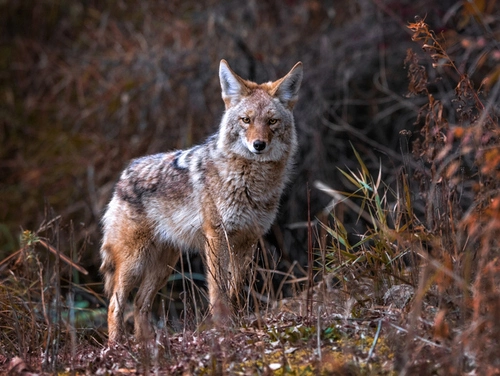
On April 3, the U.S. Fish and Wildlife Service (Service) rejected a petition filed by a group of environmental organizations under section 4(e) of the Endangered Species Act (ESA) to list the coyote (Canis latrans) as an endangered species due to its similarity of appearance to the endangered Mexican wolf (C. lupus baileyi). Section 4(e) of the ESA gives the Service the ability to list a species on the basis that its “similarity of appearance” to an endangered or threatened species imperils the protected species’ survival and recovery.
In the petition, the environmental organizations posited that illegal killings of the Mexican wolf often occur because hunters mistake the wolves for coyotes. The organizations argued that because juvenile Mexican wolves resemble coyotes in size, color, and fur pattern, and because the U.S. Department of Justice’s McKittrick Policy provides prosecutorial protection for hunters who accidentally kill a listed species due to misidentification, the Service should list the coyote. However, the Service found that the degree of the coyote’s resemblance to the Mexican wolf is not significant enough to render the two species indistinguishable, and that law enforcement personnel do not have substantial difficulty in differentiating between them. According to the Service, since differentiation is not substantively difficult for law enforcement, illegal take of the Mexican wolf can be investigated and enforced. Therefore, the Service determined that listing the coyote would have a minimal impact on the Mexican wolf’s recovery.

Nossaman’s Endangered Species Law & Policy blog focuses on news, events, and policies affecting endangered species issues in California and throughout the United States. Topics include listing and critical habitat decisions, conservation and recovery planning, inter-agency consultation, and related developments in law, policy, and science. We also inform readers about regulatory and legislative developments, as well as key court decisions.
Stay Connected
 RSS Feed
Categories
- Alternative Energy
- Bald and Golden Eagle Protection Act
- Budget
- CEQA
- CESA
- Climate Change
- Congress
- Conservation
- Construction Projects
- Consultation
- Continuing Education
- Court Decisions
- Critical Habitat
- Delisting
- Endangered Species Act
- Event
- Fish & Wildlife Service
- Freedom of Information Act
- Government Administration
- Legal
- Legislation
- Listing
- Litigation
- Migratory Bird
- National Marine Fisheries Service
- NEPA
- Off Shore Wind
- Pacific Northwest
- project
- Publications
- Regulatory Reform
- Sacramento-San Joaquin Delta
- SEPA
- Speaking Engagements
- Supreme Court
- Texas
- Timberland
- Water Issues
