
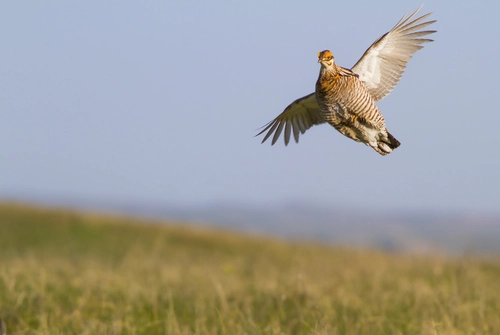
Lesser prairie-chicken
On Tuesday, September 26, President Biden vetoed two Republican-sponsored joint resolutions, S.J. Res. 9 and S.J. Res. 24, seeking to undo Endangered Species Act (ESA) protections for the lesser prairie-chicken (LEPC) (Tympanuchus pallidicinctus) and northern long-eared bat (NLEB) (Myotis septentrionalis) that became effective in January 2023.
S.J. Res. 9 would have undone the U.S. Fish and Wildlife Service’s (Service) final rule listing the Northern distinct population segment (DPS) of the LEPC as threatened with a section 4(d) rule and the Southern DPS as endangered. The LEPC is a grassland bird found in southeastern Colorado, western Kansas, eastern New Mexico, western Oklahoma, and the Texas Panhandle. The final rule concluded the LEPC is facing habitat loss and fragmentation, with the Southern DPS particularly threatened by severe droughts. President Biden cited the LEPC’s diminishing habitat, declining populations, and the conservation agreements for the species in place as reasoning for his veto.
S.J. Res. 24 would have undone the Service’s final rule listing the NLEB as endangered. The NLEB is a bat species found in 37 states, the District of Columbia, and much of Canada, facing “white-nose syndrome” (WNS), a fungal disease driving the decline of the NLEB and many other bat species. In his statement on the veto, President Biden pointed to the declines of 97 to 100 percent in affected NLEB populations as a result of WNS, and the ecological and economic benefits of bats for their roles in pest control and pollination, as factors supporting his decision.

Nossaman’s Endangered Species Law & Policy blog focuses on news, events, and policies affecting endangered species issues in California and throughout the United States. Topics include listing and critical habitat decisions, conservation and recovery planning, inter-agency consultation, and related developments in law, policy, and science. We also inform readers about regulatory and legislative developments, as well as key court decisions.
Stay Connected
 RSS Feed
Categories
- Alternative Energy
- Bald and Golden Eagle Protection Act
- Budget
- CEQA
- CESA
- Climate Change
- Congress
- Conservation
- Construction Projects
- Consultation
- Continuing Education
- Court Decisions
- Critical Habitat
- Delisting
- Endangered Species Act
- Event
- Fish & Wildlife Service
- Freedom of Information Act
- Government Administration
- Legal
- Legislation
- Listing
- Litigation
- Migratory Bird
- National Marine Fisheries Service
- NEPA
- Off Shore Wind
- Pacific Northwest
- project
- Publications
- Regulatory Reform
- Sacramento-San Joaquin Delta
- SEPA
- Speaking Engagements
- Supreme Court
- Texas
- Timberland
- Water Issues
