
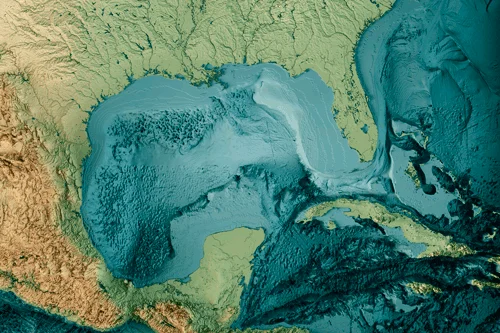
On Tuesday, March 31, 2026, the Endangered Species Committee (Committee) – colloquially known as the God Squad – met in Washington, DC at the request of the Secretary of War, Pete Hegseth. The Committee is made up of high-ranking federal government officials, chaired by the Secretary of the Interior, that can be convened under the Endangered Species Act (ESA) to grant exemptions to requirements of the ESA in certain limited circumstances. The March 31, 2026 meeting of the Committee, in which it unanimously granted an exemption for oil and gas exploration, development and production in the Gulf of America due to national security concerns, marks the first time in 30 years that the Committee has been convened. Multiple members of the Committee notes that under section 7(j) of the ESA they must grant an exemption “if the Secretary of Defense finds that such exemption is necessary for reasons of national security.”
Following the request from Secretary Hegseth, on March 16, 2026, the Department of the Interior announced the meeting in a Federal Register notice. In response, the Center for Biological Diversity (Center) filed a lawsuit in the United States District Court for the District of Columbia seeking an order to stop the meeting from occurring. In a brief order issued less than 10 days after the lawsuit was filed, the court denied the Center’s motion, holding that the Center had not demonstrated it was likely to prevail since the court lacks jurisdiction.
Congress enacted the ESA in 1973 and made significant amendments to the Act in 1978, 1979 and 1982. The ESA imposes different responsibilities on the federal government than on non-federal entities that are subject to regulation. These responsibilities are principally imposed under section 7 of the ESA. Section 7(a)(2) requires federal agencies to ensure that any action they authorize, fund, or carried out is not likely to jeopardize the continued existence of any endangered species or threatened species or result in the destruction or adverse modification of designated critical habitat. To carry out this mandate, federal agencies must consult with the U.S. Fish & Wildlife Service and/or National Marine Fisheries Service (individually the Service and collectively, the Services) whenever a proposed action may affect a listed species or its critical habitat.
As enacted in 1973, section 7 did not provide any means for a federal agency to proceed with an action that has the potential to jeopardize the continued existence of any endangered species or threatened species or result in the destruction or adverse modification of designated critical habitat. But in 1978, the Supreme Court issued its decision in the ESA case TVA v. Hill, in which the Court interpreted the ESA to require halting and reversing species extinction “whatever the cost” and then enjoined completion of the Tellico Dam (which was more than 80 percent complete and had been fully funded by Congress) on the basis that it would cause the extinction of the endangered snail darter (Percina tanasi). Fewer than five months after the Court issued its order in TVA v. Hill, Congressed amended the ESA to create the Committee and expressly provide an exemption process to balance protection of listed species and other legitimate national goals and priorities.
The ESA includes two circumstances in which the God Squad provisions can be triggered. The first circumstance allows a federal agency, governor of a state where a federal action will occur, or applicant for a federal permit or license to apply to the Secretary of the Interior for an exemption where, after completing formal consultation under ESA section 7, the Service has found the agency action will result in jeopardy to a species or destruction or adverse modification of designated critical habitat. In this circumstance, the ESA provides a detailed process that must be followed before the Committee may grant an exemption. The second circumstance in which an exemption may be granted is where the Secretary of Defense finds that such exemption is necessary for reasons of national security. In contrast to the first circumstance, in instances where an exemption is sought on the basis of national security, the ESA provides no substantive process that must be followed.
In granting the exemption, the Committee indicated it would be issuing written findings. Furthermore, Committee member Neil Jacobs, the Administrator of the National Oceanic and Atmospheric Administration, noted that the action subject to exemption included certain protections for listed species in the Gulf of America.
ESA section 7 provides that decisions by the Committee are subject to judicial review. Lawsuits challenging a Committee decision must be filed within 90 days of the Committee’s issuance of the decision in the relevant U.S. Court of Appeals. It appears nearly certain that one or more lawsuits will be filed challenging the Committee’s decision.

 Partner
Paul Weiland is Assistant Managing Partner and a member of the Environment & Land Use Group. He has represented clients – including public agencies, publicly regulated utilities, corporations, trade associations and ...
 Partner
Rebecca Hays Barho focuses her practice on natural resource law, with particular emphasis on the Endangered Species Act (ESA), the National Environmental Policy Act (NEPA), the Migratory Bird Treaty Act (MBTA), the Clean Water Act ...
Nossaman’s Endangered Species Law & Policy blog focuses on news, events, and policies affecting endangered species issues in California and throughout the United States. Topics include listing and critical habitat decisions, conservation and recovery planning, inter-agency consultation, and related developments in law, policy, and science. We also inform readers about regulatory and legislative developments, as well as key court decisions.
Stay Connected
 RSS Feed
Categories
- Alternative Energy
- Bald and Golden Eagle Protection Act
- Budget
- CEQA
- CESA
- Climate Change
- Congress
- Conservation
- Construction Projects
- Consultation
- Continuing Education
- Court Decisions
- Critical Habitat
- Delisting
- Endangered Species Act
- Event
- Fish & Wildlife Service
- Freedom of Information Act
- Government Administration
- Legal
- Legislation
- Listing
- Litigation
- Migratory Bird
- National Marine Fisheries Service
- NEPA
- Off Shore Wind
- Pacific Northwest
- project
- Publications
- Regulatory Reform
- Sacramento-San Joaquin Delta
- SEPA
- Speaking Engagements
- Supreme Court
- Texas
- Timberland
- Water Issues
