
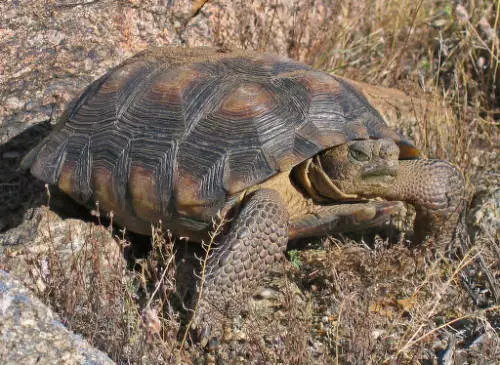
Sonoran desert tortoise
On February 8, 2022, the U.S. Fish and Wildlife Service (Service) published findings on several petitions to list species under the Endangered Species Act (ESA), some of which have been highly anticipated.
Pursuant to an August 2020 settlement agreement between the Service, WildEarth Guardians, and Western Watersheds Project, the Service published a 12-month finding on a petition to list the Sonoran desert tortoise (Gopherus morafkai). The tortoise is patchily distributed across 68,600 square miles in the Sonoran Desert ecoregion of Arizona and Sonora, Mexico. In its 12-month finding, the Service found that the petition did not present substantial scientific or commercial information indicating that listing the species was warranted. The Service based this finding, in part, on the agency’s determination that there would be ample habitat available for the tortoise at century’s end. As a result, the Sonoran desert tortoise will neither be proposed for listing nor remain on the list of species that are candidates for listing under the ESA. This is the Service’s second 12-month finding indicating that listing the Sonoran desert tortoise is not warranted.
The Service also published a 90-day finding on a petition to recognize and list the Texas population of the ocelot (Leopardus pardalis) as a distinct population segment (DPS) under the ESA. In that finding, the Service determined that the Texas population of ocelots did not meet the definition of a DPS as set forth in the agency’s DPS policy. As a result, the Service will not undertake a species status review for the Texas population of ocelots. In the United States, ocelots occur in Arizona and Texas, with the Texas population currently known from only Brooks and Cameron counties.
Finally, the Service made a positive 90-day finding in connection with a petition to list the variable cuckoo bumblebee (Bombus variabilis). The bumblebee is a wide-ranging species found in 37 states. The Service found the petition provided credible information indicating the species suffers threats due to the loss of its host species, the American bumblebee (Bombus pensylvanicus), which is currently under review by the Service for potential listing. Given the Service’s finding that the petition to list the bumblebee presented substantial scientific or commercial information that listing the species may be warranted, the agency will now undertake a more detailed status review, and must publish a 12-month finding, in which it will determine whether the species does, in fact, warrant listing.

 Partner
Rebecca Hays Barho focuses her practice on natural resource law, with particular emphasis on the Endangered Species Act (ESA), the National Environmental Policy Act (NEPA), the Migratory Bird Treaty Act (MBTA), the Clean Water Act ...
Nossaman’s Endangered Species Law & Policy blog focuses on news, events, and policies affecting endangered species issues in California and throughout the United States. Topics include listing and critical habitat decisions, conservation and recovery planning, inter-agency consultation, and related developments in law, policy, and science. We also inform readers about regulatory and legislative developments, as well as key court decisions.
Stay Connected
 RSS Feed
Categories
- Alternative Energy
- Bald and Golden Eagle Protection Act
- Budget
- CEQA
- CESA
- Climate Change
- Congress
- Conservation
- Construction Projects
- Consultation
- Continuing Education
- Court Decisions
- Critical Habitat
- Delisting
- Endangered Species Act
- Event
- Fish & Wildlife Service
- Freedom of Information Act
- Government Administration
- Legal
- Legislation
- Listing
- Litigation
- Migratory Bird
- National Marine Fisheries Service
- NEPA
- Off Shore Wind
- Pacific Northwest
- project
- Publications
- Regulatory Reform
- Sacramento-San Joaquin Delta
- SEPA
- Speaking Engagements
- Supreme Court
- Texas
- Timberland
- Water Issues
