
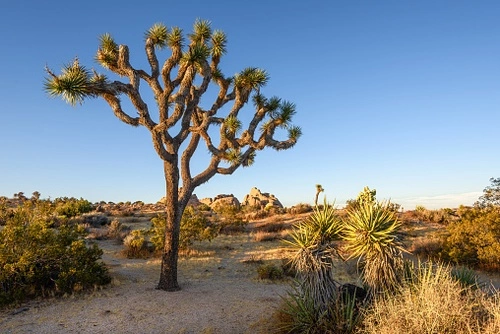
On August 15, 2019, the U.S. Fish and Wildlife Service (FWS) published a series of notices in the Federal Register announcing the agency’s 12-month and 90-day findings on petitions to list a number of species under the Endangered Species Act (ESA). Most prominently, the FWS declined to list two species commonly known as the Joshua tree (Yucca brevifolia and Yucca jaegeriana). These decisions came on the heels of the agency’s publication of proposals to, among other things, change the way these types of species listing decisions are made. (Our earlier reporting on that topic is here.)
The FWS’ decision not to list the Joshua tree occurred under the current ESA regulations, not the newly proposed ones. An environmental non-profit organization, Wild Earth Guardians, petitioned the FWS in September 2015 to list the Joshua tree as threatened and, if applicable, designate critical habitat for the species. FWS conducted an initial 90-day review of the petition, determining that the petition presented substantial scientific or commercial information indicating that listing might be warranted. FWS then undertook a more detailed 12-month review of the status of the Joshua tree.
In its 12-month finding following its species status review, the FWS noted that the primary stressors to the two species of Joshua tree include wildfire, invasive plants, the effects of climate change, and habitat loss. The FWS concluded that while these stressors are affecting individual Joshua trees, there was no evidence the trees are experiencing the stressors at a population-level or species-level scale. The FWS concluded that the Joshua tree is not in danger of extinction or likely to become so within the foreseeable future, citing, among other things, (1) the long-lived nature of the species, (2) the large ranges and distributions of the species, and (3) the fact that Joshua trees mostly occur on Federal lands.
Concurrently with its 12-month finding on the Joshua tree, FWS also made negative 12-month findings on petitions to list three species of mussels (Cyclonaias aurea, Cyclonaias houstonensis, and Alasmidonta varicosa), the tricolored blackbird (Agelaius tricolor), the yellow-banded bumble bee (Bombus terricola), the Arapahoe snowfly (Arsapnia arapahoe), and the seaside alder (Alnus maritima). In a separate notice, the FWS also made positive 90-day findings on petitions to list the lake sturgeon (Acipenser fulvescens) as endangered or threatened and to reclassify the Gila topminnow (Poeciliopsis occidentalis occidentalis) from endangered to threatened, along with a negative 90-day finding on a petition to list the Siskiyou Mountains salamander (Plethodon stormi). FWS will now conduct additional review on the lake sturgeon and the Gila topminnow, and has asked the public to provide any new scientific or commercial data or other information concerning the statuses of, or threats to, those species.

 Partner
Brian Ferrasci-O’Malley is an environmental and natural resources attorney whose practice spans both transactional work and litigation. Based in Seattle, he regularly advises clients across the United States on energy ...
Nossaman’s Endangered Species Law & Policy blog focuses on news, events, and policies affecting endangered species issues in California and throughout the United States. Topics include listing and critical habitat decisions, conservation and recovery planning, inter-agency consultation, and related developments in law, policy, and science. We also inform readers about regulatory and legislative developments, as well as key court decisions.
Stay Connected
 RSS Feed
Categories
- Alternative Energy
- Bald and Golden Eagle Protection Act
- Budget
- CEQA
- CESA
- Climate Change
- Congress
- Conservation
- Construction Projects
- Consultation
- Continuing Education
- Court Decisions
- Critical Habitat
- Delisting
- Endangered Species Act
- Event
- Fish & Wildlife Service
- Freedom of Information Act
- Government Administration
- Legal
- Legislation
- Listing
- Litigation
- Migratory Bird
- National Marine Fisheries Service
- NEPA
- Off Shore Wind
- Pacific Northwest
- project
- Publications
- Regulatory Reform
- Sacramento-San Joaquin Delta
- SEPA
- Speaking Engagements
- Supreme Court
- Texas
- Timberland
- Water Issues
